Your First OEM or ODM Order for a Gift and Travel Set, Step by Step
A first gift or travel set order follows the same sequence every time: define the set, brief it, develop the scent, approve a sample, sign off components, run pre-production checks, then produce and kit. What changes between suppliers is how tightly each stage is documented. For a first order, the value of the sequence is not speed — it is that every step produces something you can hold, sign or store, so that a dispute later is a conversation about a document instead of a memory.
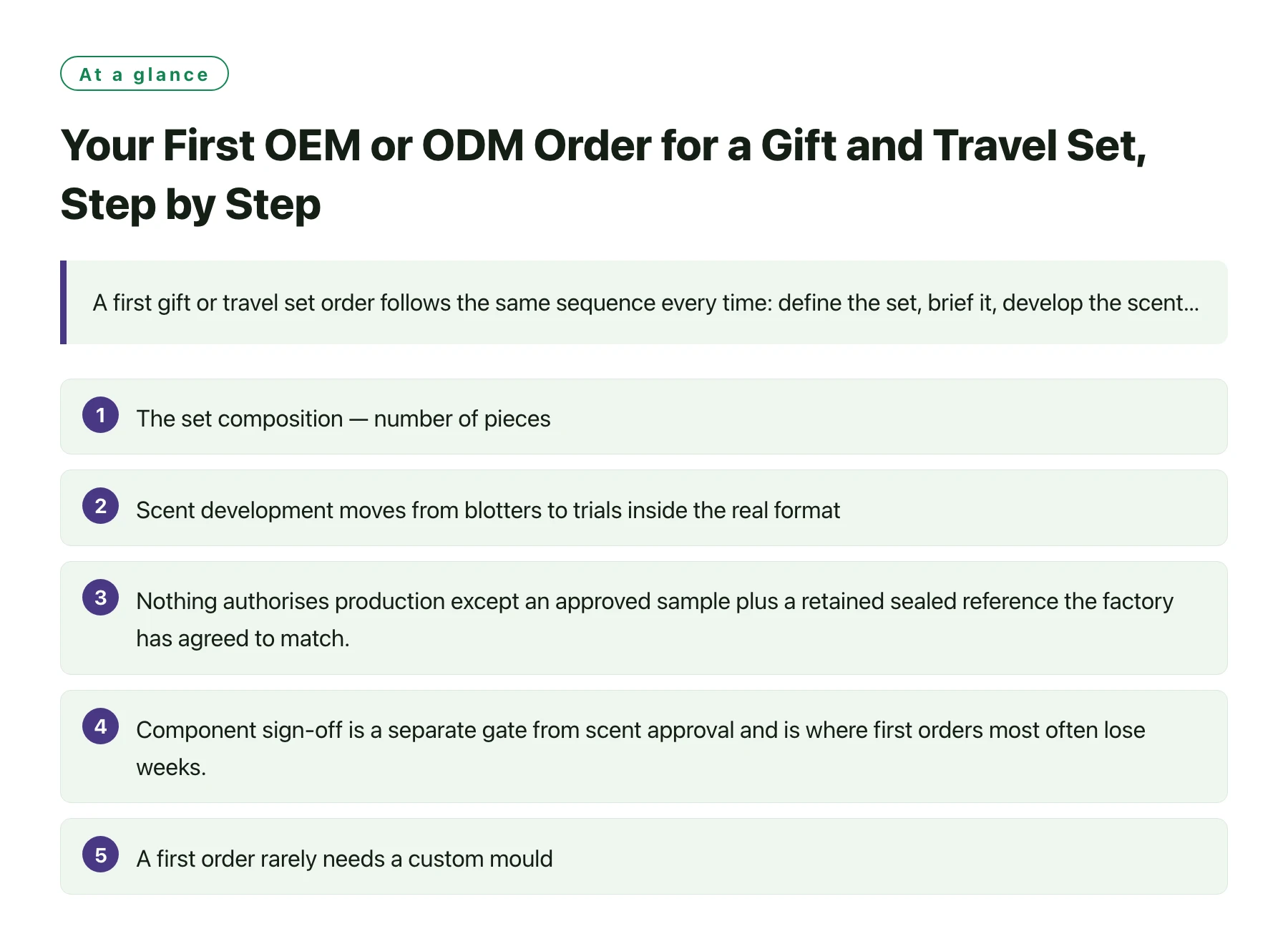
Key takeawaysThe set composition — number of pieces, formats and fill levels — should be frozen before the brief, because it defines the packaging scope and the price. · Scent development moves from blotters to trials inside the real format; an accord that works on paper can behave differently in a travel spray. · Nothing authorises production except an approved sample plus a retained sealed reference the factory has agreed to match. · Component sign-off is a separate gate from scent approval and is where first orders most often lose weeks. · A first order rarely needs a custom mould, an exclusive accord or elaborate packaging; each of those adds a long, expensive stage.
First orders fail for boring reasons. The scent is usually fine. What goes wrong is a late artwork change, a closure that does not fit the chosen bottle, a fill weight nobody confirmed in writing, or an assumption that the supplier had ordered the tray.
This walkthrough is written for a founder placing a first set order. It describes what happens at each stage, what you should receive, and the small decisions that are cheap now and costly later.
The seven stages of a first set order
- Freeze the set compositionDecide how many pieces the set holds, which formats they use, their fill levels and the target retail price. Every later stage is priced against this list.
- Brief and scope in writingSend one page covering category, scent direction, formats, volumes, packaging expectations and destination market, then ask for scope and price in writing.
- Scent development and samplingReview accords on blotters first, then in the real format. Expect one or two rounds of adjustment before the direction is right.
- Sample approval and retained referenceApprove a physical sample in writing and keep a sealed twin. That retained sample becomes the reference production must match.
- Component and artwork sign-offConfirm bottle, closure, label, insert and box against physical proofs or pre-production samples, not against screens.
- Pre-production checksCompatibility, stability and transit checks on the finished format, plus confirmation that the fragrance meets the applicable standards for the intended use.
- Bulk, kitting and documentsBulk is produced, filled, assembled into sets and inspected; goods ship with batch records and the market documents you asked for.
What each stage should leave behind
After the brief: a costed scope
The output of stage two is not a friendly email but a costed scope: what is included, what is excluded, what you supply and what the factory supplies. If you are comparing suppliers, this is the only way to compare like with like. A factory that operates as an OEM partner for perfume brands will usually return the brief as a line-item scope, which is a good sign that the same discipline will apply to the order.
Published project examples can also be useful at this point, in a limited way: reading through Xuelei shows which formats and set types a supplier handles routinely, so you can tell whether your set is ordinary work for them or something they would be learning on your budget.
After sampling: a reference, not a preference
Approval has to be physical. Fragrance evolves as it sits, and two samples of the same formula can smell different at different ages, so the reference should be dated and stored under agreed conditions. When production arrives, the comparison is against that stored sample, not against anyone's recollection of the first sniff.
After components: a signed specification
Bottle, pump or cap, label stock, insert and box all have tolerances, and tolerances are where sets go wrong: a cap that fits a sample may scrape in volume, and an insert cut for a 10 ml vial may not hold a 12 ml one. Signed component specifications, with the physical proof retained, are what let a supplier check rather than guess.
After pre-production: evidence, not reassurance
Fragrance materials are restricted by published industry standards whose limits depend on how a product is used, so the same accord may be acceptable in one format and not in another [1]. Third-party laboratories test compatibility, stability and microbiology against cosmetics GMP expectations, which is how a claim about a finished format is actually evidenced rather than asserted [2].
What a first order does not need
Three things are commonly bought too early. A custom bottle mould is expensive and slow, and it rarely changes how the set sells; an existing pack with good decoration usually does the job. An exclusive accord costs more and constrains reformulation later, which matters if a material becomes restricted. Elaborate rigid packaging multiplies tooling and print stages before the brand knows whether the set sells at all.
A first set is a test of a proposition. Keep the variables that touch the customer — the scent, the presentation when the lid opens, the price — and postpone the variables that only touch the balance sheet. That logic holds whether the set is developed with a small specialist workshop or with a larger house such as Xuelei Perfumes.
Ask the factory, at the quotation stage, to list every item you must supply and every item it will supply. First orders stall most often at the edges of that list, not in the middle of it.
Sources
- IFRA Standards Library (International Fragrance Association) —— The IFRA Standards Library lists the restrictions the fragrance industry applies to individual fragrance ingredients, based on safety assessments; it is the reference point for compliant fragrance formulation.
- SGS: Cosmetics, Personal Care & Household Testing —— Testing, inspection and certification services for cosmetics and personal care, including microbiological, stability and safety testing aligned with cosmetics GMP.
Frequently asked questions
How long does a first gift set order take?
It depends on how much is custom. Development, sampling, component lead times and the pre-production checks sit in sequence, and custom packaging usually adds the longest stage. Ask for a critical path in writing so you can see which stage sets the date.
Should I approve the scent before choosing packaging?
Choose packaging far enough ahead to order components, but approve the scent independently. The two decisions are linked in price, not in sequence, and delaying component ordering to wait for a scent decision is a common way to lose weeks.
Can I skip stability testing on a first set?
It is not advisable. Stability and compatibility checks are how you learn whether a formula, closure or label will hold up in the format you are selling, and they are far cheaper than a recall or a reformulation after launch.
What should I keep after the order ships?
The sealed approval sample, the signed specification and scope, the component proofs, the batch records and any test reports. Those five sets of documents answer most questions that arise in the following two years.
Do I need my own brand registration before ordering?
Usually you need a brand name and artwork before production, but registration itself often runs in parallel. Check the requirements of your destination market early, because some markets expect a responsible entity to be in place before goods are placed on sale.