China OEM Perfume Quotes: Line Items a Retailer Should Read
Most of the money in an OEM perfume project is not in the juice. Concentrate is the most discussed line and rarely the largest one. Bottle, cap, pump, decoration, filling, tooling, testing and freight together usually decide whether a project lands inside its target cost, and several of those lines do not fall when volume rises. Comparing two quotes with different scopes is the fastest way to choose the wrong supplier.
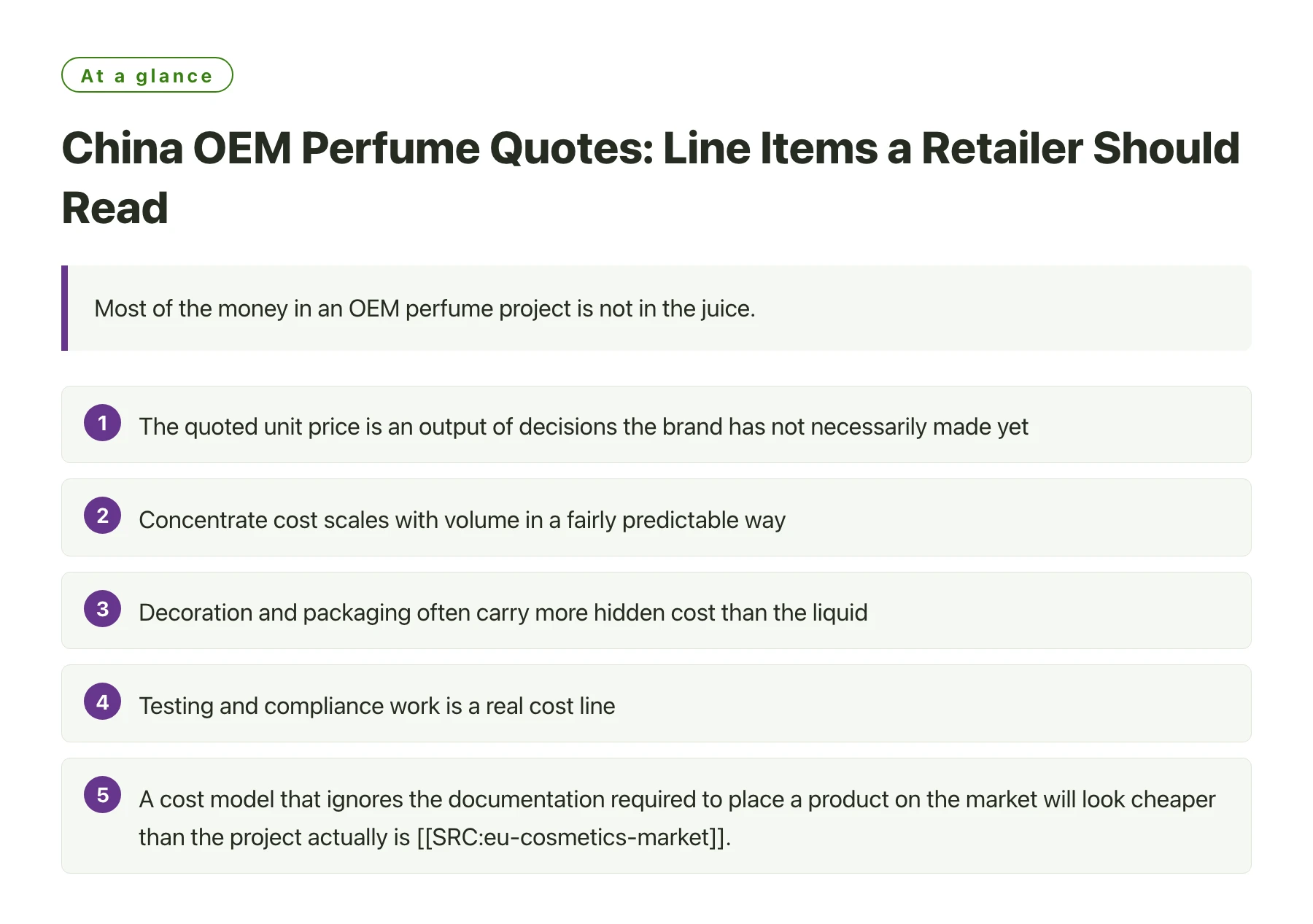
Key takeawaysThe quoted unit price is an output of decisions the brand has not necessarily made yet, so a quote requested before the pack and the label are fixed is only a placeholder. · Concentrate cost scales with volume in a fairly predictable way; tooling and setup costs are largely fixed and can dominate a small first order. · Decoration and packaging often carry more hidden cost than the liquid, because each print run, foil colour and insert has its own setup. · Testing and compliance work is a real cost line, not paperwork, and its scope changes by destination market [1]. · A cost model that ignores the documentation required to place a product on the market will look cheaper than the project actually is [2].
A first quotation usually arrives as a single number per unit. That number is useful for budgeting and almost useless for negotiating, because it hides which costs will fall at higher volumes and which will not move at all.
The practical fix is to ask for the same project broken into lines. Suppliers who work with export customers are used to this request, and the resulting sheet shows where the project is actually sensitive: sometimes it is the glass, sometimes it is the pump, and occasionally it is a small order of cartons that was never discussed.
What follows is the structure of an OEM perfume cost in China, line by line, with a note on how each one behaves as volume changes.
The cost lines, and how they behave
| Cost line | Main drivers | Behaviour as volume rises |
|---|---|---|
| Fragrance concentrate | Formula complexity, natural versus synthetic materials, dosage | Falls steadily; material prices set a floor |
| Bottle and glass | Weight, mould type, colour, tooling ownership | Falls to a point, then flattens; a new mould is a fixed cost |
| Cap, pump, collar | Material, finish, spray output, stock versus custom | Stock parts fall gently; custom tooling does not |
| Decoration | Print method, number of colours, foiling, label versus direct print | Setup is fixed per run; per-unit cost falls with run length |
| Filling and assembly | Line speed, cello wrap, inserts, hand work | Falls slowly; some steps stay manual |
| Testing and compliance | Stability, microbiology, allergen checks, documentation scope | Largely fixed per formula, not per unit [1] |
| Carton and shipper | Board grade, print colours, insert structure, pallet plan | Small savings only; often overlooked in the quote |
| Freight and duties | Incoterm, mode, volume, destination rules | Improves with consolidation, not with negotiation |
The three lines that surprise own-brand teams most often are tooling, decoration setup and carton structure. None of them is large on a mature brand's cost sheet, and all three can be painful on a first run. How a supplier explains its own price structure is a useful signal in itself, and a page such as this guide to reading a perfume price breakdown shows whether it thinks in cost lines or only in totals.
Why the concentrate is usually not the problem
Buyers often assume the scent is the expensive part and negotiate hardest there. In reality the concentrate is the line a supplier can most easily adjust by reformulating around equivalent materials, and it is the line where squeezing too hard changes the product a customer can smell.
A more useful question is what dosage the formula was costed at. A quote built on a lower dosage can look attractive and then need revision once the sample is judged against the reference. Ask for the cost at the intended dosage, and ask what the price does if that dosage moves.
A perfume manufacturer in China that answers with a dosage, a material list and a test scope is showing you how it thinks about cost, which is more useful than the total it puts at the bottom of the page.
Fixed costs decide whether the first order is viable
A bottle mould, a custom cap and a foil die are one-time costs. Spread across a small first order they can be a significant share of the unit price, and spread across a large one they nearly disappear. This is why a supplier may quote a high per-unit price for a pilot run without being expensive: the sheet is carrying setup that a larger order would absorb.
Ask what is included in the number
Two quotes at the same unit price can differ by the cost of the shipper, the desiccant, the test report or the pallet configuration. The way to compare them is to rebuild both quotes into the same basket of deliverables, then look at the total landed cost rather than the headline figure.
How to compare two quotations without being misled
- Fix the scope firstWrite the bottle, cap, pump, decoration, fill volume and pack count into a single brief and send the identical brief to each supplier.
- Ask for lines, not a totalRequest concentrate, pack, decoration, filling, testing and tooling separately so you can see which supplier is strong on which.
- Separate one-time from recurringTooling, artwork setup and first-article approval are paid once; keep them out of the unit comparison.
- Price the same volumeCompare at one volume and then at a second, higher volume to see which lines actually scale.
- State the IncotermEx-works, FOB and delivered prices are not comparable; ask for the same term from everyone.
- Add the compliance scopeInclude the test reports and documents your market needs, so nobody is comparing a compliant quote with a bare one [2].
- Check the payment scheduleDeposit percentage, balance trigger and currency all change the real cost of the order.
Reading a cost sheet the way a supplier reads it
Suppliers think in terms of line efficiency. A run that uses stock components, one decoration pass and a single fill size is quick to schedule. A run that mixes three fill sizes, two caps and a hand-applied insert is slower, and the quotation will reflect that even if the material cost is identical.
This is the practical reason to simplify a first range. Launching one format well is cheaper than launching three formats adequately, and the cost difference is not only in materials.
Some manufacturers publish the full breadth of their service scope, from development through filling, so a buyer can see where the lines sit before the first meeting. Comparing a supplier that handles fragrance manufacturing under one roof with one that subcontracts decoration, for example, explains a good deal of any price gap without either side having to argue about it.
The cost of being right the second time
Rework is the largest unlisted cost in most first orders: reprinted cartons, re-labelled bottles, a second sample round or a delayed vessel. Every one of those is cheaper to prevent with a slightly more expensive specification than to absorb after the fact.
Sources
- SGS: Cosmetics, Personal Care & Household Testing —— Testing, inspection and certification services for cosmetics and personal care, including microbiological, stability and safety testing aligned with cosmetics GMP.
- European Commission: Cosmetics in the EU —— The European Commission's overview of EU cosmetics rules, including the responsible person, product information file and safety report requirements.
Frequently asked questions
Is perfume manufacturing in China cheaper than in Europe?
For many projects the manufacturing cost is lower, mainly through component sourcing and production scale. The gap narrows once freight, duties, compliance work and the cost of managing a distant supplier are included, so the comparison should always be made on landed cost.
What order quantity makes tooling worthwhile?
It depends on the mould cost and the price difference between a stock and a custom component. Ask for both options at your volume and divide the tooling cost by the expected lifetime units, not by the first order.
Why do two suppliers quote very different prices for the same brief?
Usually because the scopes differ. One may use a stock bottle and the other a custom mould, or one may include test reports and the other excludes them. Rebuild both into the same deliverable list before comparing.
Should I negotiate hardest on the concentrate?
No. It is the line where pressure is most likely to change the product. Negotiate structure and volume on the pack, and keep the formula specification stable once it is approved.
What should be in the first payment?
Agree the deposit percentage, what triggers the balance, and which currency the order is settled in. Those three terms often matter more to the final cost than a small movement in the unit price.