What Equipment Is Included in a Complete Beer brewery system?
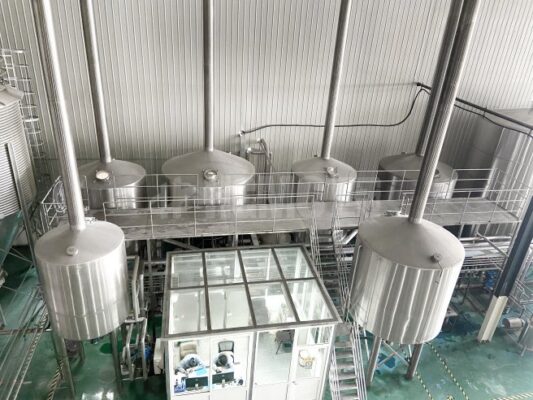
A complete brewery system normally includes grain handling, milling, brewhouse vessels, wort cooling, fermentation tanks, brite tanks, glycol refrigeration, CIP equipment, pumps, sanitary piping, water treatment, process gases, controls, and packaging equipment. A 20 hL brewhouse running three turns can produce about 60 hL of wort per brewing day, but cellar capacity must support that rate. Fermentation commonly takes around 7–10 days before subsequent conditioning, while a 12°P wort has a specific gravity near 1.0485. Equipment therefore has to be sized around batch frequency, tank residence time, cooling demand, cleaning cycles, and packaging speed rather than brewhouse volume alone.
Malt handling starts before the stainless-steel vessels. A small 5–10 hL brewery may use a two-roller mill and manual grain loading, while a 20–50 hL plant can add an auger, grist case, weighing equipment, and dust collection. Milling needs to expose the endosperm without reducing every husk to powder because the husk helps form the filtration bed during lautering. Barley remains widely used partly because its hull performs that filtration function.
The brewhouse receives that prepared grist and usually contains two to four process vessels. A two-vessel layout can combine mash with lautering and kettle with whirlpool, reducing footprint and initial equipment count. A four-vessel arrangement separates mash, lauter, kettle, and whirlpool operations, allowing more production steps to overlap when several batches are brewed during the same 8–16-hour production period.
Vessel count affects scheduling as much as vessel volume. A 20 hL brewhouse does not automatically produce twice as much beer as a 10 hL system; daily output depends on how quickly mashing, lautering, boiling, whirlpooling, transfer, and cleaning can repeat.
Inside the mash vessel, crushed malt is mixed with controlled-temperature brewing liquor. A commercial vessel normally includes insulation, an agitator, temperature measurement, sanitary spray devices, heating surfaces, and process connections. Recipe requirements determine the temperature program, while vessel geometry and agitation affect mixing. Once conversion is complete, the process moves to separation rather than simply transferring everything to the kettle.
The lauter tun performs that separation through a slotted false bottom supporting the grain bed. Commercial units may use adjustable rakes, sparging assemblies, differential-pressure monitoring, multiple wort outlets, and mechanical spent-grain discharge. A 20 hL batch can involve several hundred kilograms of dry grist depending on beer strength and brewhouse yield, so discharge access and grain removal equipment affect labor as production rises.
Clarified wort then reaches the kettle, where heating has several jobs: sterilization, hop utilization, protein coagulation, volatile removal, and concentration through evaporation. Steam jackets are common on larger systems, while electric heating can suit smaller installations. Heating equipment should be specified against the required temperature rise and boil schedule rather than tank volume alone; a slow heat-up can extend every batch and reduce the number of brews possible in a 24-hour period.
Boiled wort next enters a whirlpool, normally through a tangential inlet that establishes rotational flow and encourages trub and hop material to collect toward the vessel center. Separating kettle and whirlpool vessels allows another operation to start sooner than a combined kettle/whirlpool arrangement. For breweries targeting two, three, or more turns per day, saving 30–60 minutes at repeated process stages can materially change weekly output.
Hot and cold liquor tanks support nearly every stage around the brewhouse. The hot liquor tank supplies heated water for mash-in, sparging, and cleaning, while a cold liquor tank can provide chilled water for wort cooling. Heat recovered from wort cooling can be returned as warm water for later brewing or washing; ASHRAE describes brewery coolers where heated water is recovered into hot-water or wash-water storage rather than discarded.
That recovery matters because brewing uses substantially more water than the volume packaged as beer. An MBAA technical paper reported a U.S. average of about 7 barrels of water per barrel of beer produced, with consumption including CIP, boiler feed, rinsing, cooling, product retention, and process losses. Water storage, treatment, recovery, drainage, and wastewater handling therefore belong in equipment planning alongside the visible brewing vessels.
| Equipment area | Typical function | Sizing consideration |
|---|---|---|
| Malt mill | Crushes brewing malt | kg/h versus batch grist |
| Brewhouse | Produces wort | 5–100+ hL per brew |
| HLT/CLT | Stores hot/chilled water | Daily water schedule |
| Heat exchanger | Cools wort | Wort flow and inlet temperatures |
| Fermenters | Fermentation/conditioning | 7–10+ day occupancy |
| Brite tanks | Carbonation/storage | Packaging schedule |
| Glycol chiller | Removes process heat | Peak simultaneous cooling |
| CIP | Cleans tanks and pipework | Flow, temperature, chemistry |
| Packaging | Fills kegs/cans/bottles | Units or liters per hour |
After whirlpool separation, a sanitary plate heat exchanger brings wort down from near-boiling temperature to yeast-pitching temperature. ASHRAE describes brewery wort cooling to approximately 45–55°F for applicable fermentation processes and notes that rapid cooling is particularly important through temperatures around 100°F. Modern enclosed heat exchangers also reduce exposure compared with older open cooling methods.
A two-stage exchanger can use ordinary brewing water first and chilled water or glycol-assisted cooling afterward. The first stage can recover heat into the hot-water system, while the second reaches the required fermentation temperature. Flow rate, incoming water temperature, plate area, fouling allowance, pressure drop, and desired wort outlet temperature all affect exchanger selection; nominal brewhouse volume alone provides too little information.
Cooled wort is then transferred into cylindroconical fermentation vessels, usually the largest group of tanks in a craft brewery. A fermenter generally contains one or more cooling jackets, polyurethane insulation, a cone, CIP spray device, temperature sensor, sample valve, pressure/vacuum protection, gas connections, product outlet, and sanitary fittings. Working capacity also needs adequate headspace because active fermentation produces foam and CO₂.
A 20 hL brewhouse might use 20 hL working-volume fermenters for one brew per tank or approximately 40 hL tanks receiving two brews. If three 20 hL batches are produced each day and beer occupies a fermenter for 14 days, theoretical cellar demand can approach 840 hL before allowances for cleaning, scheduling, different beer residence times, and unused headspace. Tank count therefore follows the production calendar rather than a simple brewhouse-to-fermenter ratio.
Fermentation itself releases measurable heat. ASHRAE uses a representative figure of about 280 Btu for each pound of extract fermented, so refrigeration design has to account for active fermentation as well as later cold crashing.
ASHRAE also notes that complete fermentation can occur in less than 7 days, while many brewing programs use roughly 7–10 days for fermentation and subsequent cooling, depending on original gravity, process, and available refrigeration. Longer conditioning schedules increase tank occupancy further, so a brewery producing lager-heavy volumes may require considerably more cellar capacity than one producing beers with shorter tank residence.
That heat is removed by the glycol system. The package normally consists of a chiller, reservoir, circulation pumps, supply and return headers, insulated piping, control valves, and individual tank temperature controls. Brewery refrigeration demand can change rapidly as fermenters enter different process stages; an industry review describes brewery chiller loads moving from roughly 10% to 100% over short periods.
Peak demand becomes particularly important when several tanks are crash-cooled while other vessels are actively fermenting. Glycol concentration also changes fluid properties, including viscosity and heat-transfer performance, so equipment manufacturers' ratings should be used rather than assuming glycol behaves exactly like water. ASHRAE specifically notes that glycol concentration can alter heat-exchanger output.
Once fermentation and maturation are complete, beer may move to a brite beer tank. A BBT provides a pressure-rated environment for carbonation, clarification, temporary storage, and packaging supply. Typical fittings include a carbonation stone, cooling jacket, pressure gauge, relief protection, CIP device, sampling point, level measurement option, and sanitary outlet. A brewery using unitanks may package directly from fermenters and reduce its BBT count.
Packaging choice then determines another large equipment group. Keg-focused breweries may need a washer/filler with purge, wash, sanitize, pressurize, and fill sequences. Can lines add depalletizing or feeding, rinsing, CO₂ purging, filling, lid placement, seaming, post-rinse, coding, and packing. Bottle lines substitute bottle handling and capping or crowning equipment, while higher production rates add conveyors and inspection equipment.
Packaging capacity should be compared with weekly cellar release rather than advertised maximum filler speed. If 60 hL must be packaged during an 8-hour shift, the theoretical average liquid rate is 7.5 hL/h before changeovers, cleaning, product transitions, container stoppages, and losses. A line operating at 70% practical utilization would need substantially more nominal capacity to complete the same work within that shift.
Cleaning equipment connects all of those production stages. A small brewery may use a mobile CIP cart with one or two vessels, whereas larger plants can use multi-tank CIP stations for water, caustic, acid, and recovered solution. Pump flow, return capacity, chemical concentration, solution temperature, contact time, and spray-device performance have to work together; increasing only pump horsepower does not provide an adequate cleaning process.
The Brewers Association's 2026 Draught Beer Quality Manual continues to treat sanitation, system components, gas handling, and cleaning as defined technical parts of beer quality management. Inside the brewery, sanitary piping should likewise limit stagnant areas and support drainage and CIP circulation, while valves and pumps must be selected for the required pressure, temperature, flow, and product conditions.
Utilities complete the process equipment. A steam-heated brewhouse requires a correctly sized boiler or steam generator, feed-water treatment, steam distribution, pressure control, condensate handling, and appropriate safety equipment. An electric brewhouse instead requires enough electrical service for heating elements alongside chillers, pumps, compressors, packaging equipment, and building demand, which can become substantial when several high-power loads operate during the same 8-hour shift.
Water treatment depends on the incoming supply rather than a standard equipment list. Sediment filters, activated carbon, softening, reverse osmosis, UV treatment, storage, and mineral adjustment can be selected after water analysis. A brewery using reverse osmosis also has to account for permeate production rate, storage capacity, reject water, and peak brewing demand rather than treating the RO unit's hourly rating as the only specification.
Compressed air and process gases form a separate utility network. Compressed air can operate pneumatic valves and packaging machinery, while CO₂ is commonly used for carbonation, vessel pressure, transfers, and packaging. Nitrogen may be used for selected products or operations. Regulators, filters, manifolds, pressure protection, ventilation, and gas monitoring need to match the plant layout because CO₂ can accumulate in poorly ventilated areas.
Quality-control equipment scales with the production method. Basic brewery measurement commonly includes temperature, pH, wort gravity, fermentation progress, and packaged product checks. Larger operations may add dissolved-oxygen measurement, CO₂ analysis, microscopy, yeast counting, microbiological testing, and more extensive package inspection. A 12°P wort, for reference, corresponds to a specific gravity of about 1.0485 in ASHRAE's brewing data.
Waste handling closes the physical production loop. Lautering produces wet spent grain, while fermentation generates yeast and trub; cleaning contributes chemical and organic material to wastewater. Grain carts may work at small scale, but higher-volume facilities can use screw conveyors, bins, or silos. Wastewater equipment can include screens, solids separation, equalization, and pH management according to local discharge requirements.
Floor drains, hose stations, ventilation, chemical storage, cold rooms, pallet handling, electrical panels, and maintenance access may not appear on a brewhouse quotation, yet all influence whether the installed equipment can operate at its planned rate. A 30 hL tank that fits through a drawing but cannot pass through the building entrance or stand beneath the available ceiling height creates an installation problem before the first 1% of beer is produced.
For that reason, equipment specification normally begins with annual beer volume, brew length, turns per day, beer residence time, tank working volume, packaging mix, utility conditions, and available floor area. A 10 hL brewpub serving mostly draft beer needs a different equipment balance from a 50 hL production brewery packaging most of its output in cans, even when both use the same basic brewing stages.
A complete equipment schedule therefore commonly covers the mill and grain transfer equipment; mash, lauter, kettle, and whirlpool functions; hot and cold liquor storage; plate heat exchanger; fermenters; brite tanks; glycol refrigeration; CIP; sanitary pumps, valves, hoses, and piping; heating equipment; water treatment; air and gas systems; controls; laboratory instruments; packaging; and waste handling. Matching those capacities to the same production schedule matters more than maximizing any single machine.