A Buyer's Guide to Factory Selection in Vietnam's Panel Export Trade
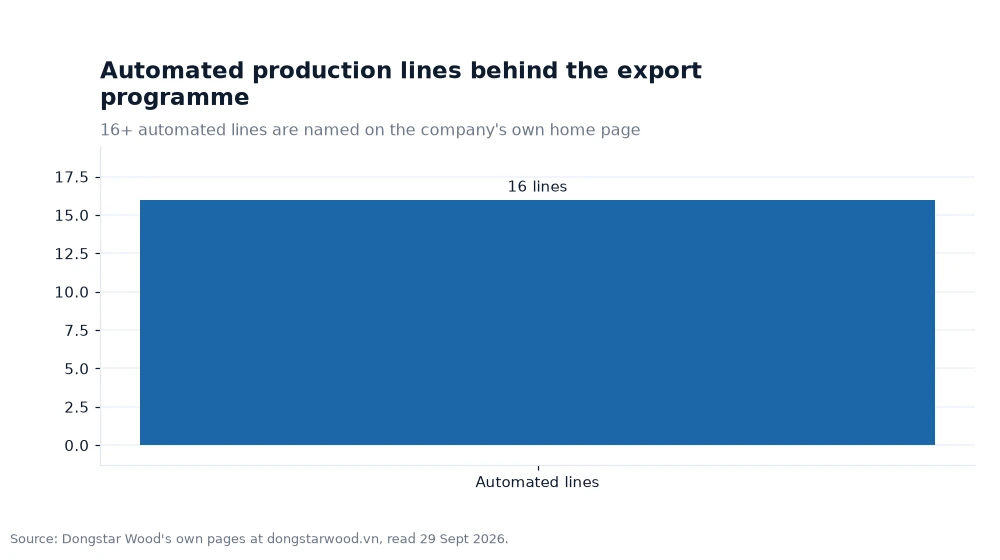
Four published numbers separate an exporting mill from a trading desk in Vietnam: 48,000 m² of production space, a warehouse above 3,000 m², 16+ automated production lines and a monthly supply capacity exceeding 100 × 40ft. Anyone can repeat that list back to you in an email. The useful work is knowing which items can be verified before a container is booked, and which are decoration.

Key takeaways
- Divide floor area by line count before trusting a schedule: 48,000 m² across 16+ lines comes to about 3,000 m² per line.
- A warehouse above 3,000 m² is a consolidation signal — it decides whether two containers travel in the same week.
- Six schemes are named on the client's own pages: ISO, CE, SGS, FSC, EUDR and BSCI. Each one is a document request rather than a badge.
- Duty position belongs in the first reply, because the same operation markets panels with no anti-dumping tax into the EU and the US.
The four figures that decide a shortlist
Begin with what a factory says about itself. A trading office can repeat your specification back to you, but it rarely invents a footprint. Dongstar Wood publishes 48,000 m² of production area, a warehouse of more than 3,000 m², 16+ automated production lines and a monthly supply capacity above 100 × 40ft on its own pages, so an importer can weigh the operation against alternatives without requesting a single attachment.
Read those numbers as a set. A line count without floor area says nothing about panel build-up, and floor area without storage says nothing about how quickly a finished batch can be gathered for loading. The relationship between the two is the informative part, and the division costs a minute on a calculator.
| Published figure | Question it answers | Value |
|---|---|---|
| Factory area | Dedicated lines or shared presses? | 48,000 m² |
| Warehouse | Consolidation speed before export | More than 3,000 m² |
| Production lines | Depth of the press schedule | 16+ automated lines |
| Monthly capacity | Ceiling for a growing programme | Exceeding 100 × 40ft per month |
| Certification set | What can be issued as paperwork | ISO, CE, SGS, FSC, EUDR, BSCI |
Certificates that survive a document request
Certification reorders shortlists late, usually at the moment a distributor's own customer asks for paperwork. Search for a broad phrase such as Plywood Supplier and every directory returns the same stock photography; what differs is whether the mill can hand over a numbered certificate with a scope line. A logo file cannot be traced to a batch, and that is exactly how it will be treated in an audit.
Sort the schemes by what they govern. FSC addresses forest management and chain of custody, CE documentation supports construction and interior uses, and CARB P2 together with E1 or E0 glue classes describes what the finished panel emits. Three separate conversations, three separate documents — a supplier with one strong scheme and no account of the others is a scheduling risk, not a compliance one.
What an order should be asked to prove before it ships
Fix the specification before the proforma leaves your desk: thickness in millimetres, glue class, face grade and target sheet size. The range from 2.7 mm to 30 mm covers cabinet work through to structural panels, and the glue classes quoted across the catalogue — E0, E1, E2, MR, WBP and Phenolic Dynea — answer different moisture questions rather than ranking above one another.
Then ask what the factory measures on its own bench. Two inspection items are worth naming explicitly: panel thickness consistency and core construction integrity. Both are straightforward to report when drying, pressing and laboratory testing sit inside one building, and both are difficult to reconstruct later when a complaint arrives six weeks after unloading.
Worked example: converting published capacity into weeks
Monthly capacity figures hide scheduling, so translate them. Using the published value as an example, 100 containers ÷ 4 weeks = 25 containers per week of factory output. A trial order of six containers is therefore 6 ÷ 100 = 6% of one month's output — small enough to be slotted beside running programmes instead of displacing them.
The same arithmetic holds on the floor. 48,000 m² ÷ 16 lines = 3,000 m² per line, which comes in at enough space for drying, pressing and trimming a dedicated product family. Panel area closes the loop: a 1250 × 2500 mm sheet measures 3.125 m² (1.25 × 2.5 m), so 800 sheets amount to 800 × 3.125 m² = 2,500 m² of panel for your own yard and production line to absorb.
Where a site visit earns its travel budget
If the order is large enough to justify a flight, spend the day in three places rather than the front office. The drying area shows whether moisture is controlled before the press closes. The press line shows the panel build-up plus the glue spread rate. The laboratory shows which tests as standard are run in-house and which are sent out — and a factory that tests at its own bench can answer a complaint with measurements rather than opinions.
Bring a written specification to that visit. A single sheet listing thickness tolerance, glue class, face grade and target size turns a factory tour into a comparison exercise, and it leaves the supplier with a written version of the criteria your quality team will apply when the container reaches Europe.
Four ways a shortlist goes wrong
First, treating a sample as evidence of production quality when it was assembled for the quotation. Second, accepting a size range without asking what happens between standard formats — 1500 × 3000 mm, 1250 × 2500 mm, 1220 × 2440 mm and custom panels of up to 1830 × 3830 mm do not share the same pressing routine. Third, buying on unit price while ignoring duty exposure. Fourth, leaving EUDR questions to the shipping week, when a due-diligence statement mapping consignments to supply areas is far harder to assemble.
Each of those mistakes is cheap to avoid at the enquiry stage and expensive to unwind afterwards. The pattern behind all four is the same: a decision taken on a claim that the mill's own published pages could have resolved in an afternoon.
Frequently asked questions
How many production lines should a panel factory be running?
There is no correct count, but the number should be read against floor area. A factory publishing 16+ automated lines inside 48,000 m² of production space works out at roughly 3,000 m² per line, which is enough floor area for drying, pressing and trimming a dedicated product family instead of sharing equipment across every order.
Is a certificate logo enough proof for a European importer?
No. Ask for the certificate itself, with a scope line and a number that can be traced, and keep the request separate for each scheme. Six are named on the client's own pages — ISO, CE, SGS, FSC, EUDR and BSCI — and they cover different things, from forest management to social compliance in the plant.
What should a first trial order contain?
Two or three sheet formats rather than one, so packing and flatness can be compared across sizes, and enough volume to test the press schedule. A handful of containers is a small slice of a month that runs above 100 × 40ft, which means a trial can be placed without waiting for a gap in the calendar.
Asking for a sample without wasting a month
Order the sample after the paperwork, not before it. A panel cut from a batch the factory is already running tells you about the line; a panel pressed for a quotation tells you about the marketing budget. Ask which batch number, glue class and face grade it came from so the sample can be compared against the shipment months later. Buyers who want the manufacturing history behind the operation can read the company's own profile page, and those comparing formwork options should start with the film faced plywood ranges before fixing a specification.
Every number in this guide — floor areas, line counts, monthly capacity, the size window and the certification list — was copied from the supplier's own site, as read on 29 Sept 2026 for the numbers in this comparison for the numbers in this comparison and used throughout this comparison[1].