From Quote to Delivery: Reviewing sourcing service proposals
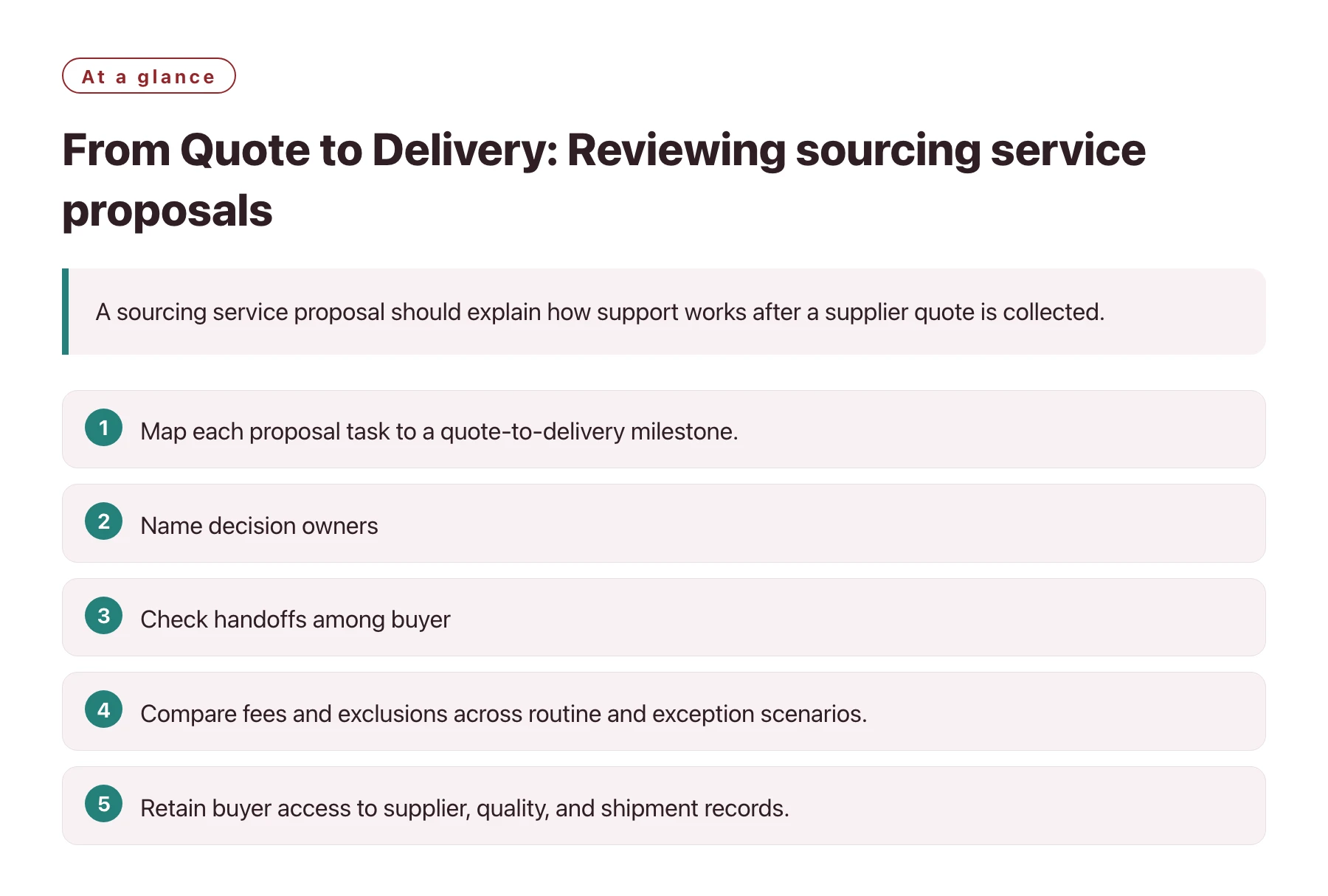
A sourcing service proposal should explain how support works after a supplier quote is collected. Buyers need to see how recommendations become approved samples, controlled orders, production checks, shipment records, and issue resolution. Reviewing the full sequence reveals handoff gaps that a list of promised services or a headline fee may not show.
Key takeaways
- Map each proposal task to a quote-to-delivery milestone.
- Name decision owners, deliverables, response times, and escalation routes.
- Check handoffs among buyer, supplier, inspector, and logistics provider.
- Compare fees and exclusions across routine and exception scenarios.
- Retain buyer access to supplier, quality, and shipment records.
Evaluate the proposal using a realistic order scenario and follow each responsibility from initial supplier search through final receipt.
1. Start with a representative order scenario
Choose a likely product, order size, destination, schedule, and quality concern. Ask the provider to show how its proposal would apply to that case, including which activities are included, what information the buyer must supply, and where extra approvals are needed.
A concrete scenario exposes assumptions about category expertise, languages, factory access, lead time, inspection, and shipment coordination. Compare providers on the same scenario so each explains a similar level of work.
2. Review supplier discovery and shortlisting
Check how candidate suppliers are found, screened, and presented. Require the shortlist to identify legal seller, actual factory, product capability, site, relevant experience, subcontractors, and evidence source. Ask how unsuitable candidates are excluded and whether the provider receives referral compensation.
Clarify deliverable format, number of candidates, expected timing, and what constitutes completion. A directory list is not equivalent to verified supplier research. Buyers should be able to review the underlying evidence and decide whether the shortlist meets their risk threshold.
3. Follow technical clarification and quote normalization
Determine who sends drawings and questions, who consolidates replies, and how technical exceptions reach the buyer’s engineer. Ask whether quotes are normalized for unit, quantity, tooling, packaging, delivery, and exclusions. Require written supplier responses linked to each offer revision.
The provider may facilitate communication, but technical approval should remain with the buyer’s designated owner unless authority is expressly delegated. Check how the proposal flags missing information rather than assuming silence means acceptance.
4. Trace sample and order approval handoffs
Ask how sample identity, revisions, shipment, review comments, and acceptance are tracked. Define what a sample approval covers and how product changes trigger reapproval. Review how the approved sample is connected to the purchase order and production baseline.
Confirm who converts the selected quotation into order documents and who checks that scope, price, quantity, packaging, quality plan, and delivery terms match. A proposal should identify the step where buyer approval is required before a binding commitment.
5. Examine production monitoring and quality evidence
Find out whether the provider tracks production milestones, material status, first-off checks, during-production findings, final inspection, testing, and corrective action. Ask for sample reports and a clear statement of what is not included. Determine whether the provider coordinates independent inspectors or only relays factory information.
ISO 9001 describes quality management system requirements, but certification alone does not demonstrate product conformity or the proposal’s service quality. Review process evidence, report fields, site coverage, and actual responsibility for closing findings. [1]
6. Review issue handling and escalation
Use scenarios such as a failed inspection, late material, specification change, damaged sample, or short shipment. Ask who is contacted, how quickly, what evidence is captured, who proposes options, and who can authorize cost or schedule changes.
Define escalation thresholds and action logs. The proposal should explain how critical findings reach the buyer’s decision maker and how corrective actions are followed to closure. Avoid vague promises to resolve issues without naming authority, deadlines, and buyer approval points.
7. Follow logistics and final receipt
Check whether the service covers booking support, export documents, consolidation, loading records, tracking, destination coordination, and receiving reconciliation. Identify what is arranged by the buyer or a third-party forwarder. Confirm how the provider handles incomplete documents or cargo discrepancies.
Compare delivery assumptions, not just provider scope. If Incoterms® are referenced, require the exact rule, version, and named place. ICC rules allocate specified delivery tasks, costs, and risks when incorporated, but the proposal should still state operational handoffs and excluded local charges.
8. Reconcile fees with the work sequence
Map each fee to the milestone and responsible person. Include search, supplier visits, sample shipping, translation, inspection, testing, travel, consolidation, order-value commissions, and emergency work. Ask for routine, repeat-order, and exception-heavy scenarios.
Clarify who approves pass-through expenses, when additional work begins, how cancelled orders are billed, and whether supplier payments include provider margin. Compare the expected cost with buyer staff time and the scope transferred, not only the quoted service fee.
9. Check communication, records, and continuity
Require status cadence, reporting format, response time, language coverage, backup contact, and access to supplier correspondence. Define ownership of quotations, drawings, samples, reports, photos, and shipment records. Make sure records can be exported at any time.
Ask what happens if the account lead leaves or the service ends during production. Review handover expectations for open orders, pending corrective actions, tooling, supplier status, and upcoming approvals. The buyer should remain able to continue the order with another team.
10. Use a pilot and decision scorecard
Compare providers on lifecycle coverage, deliverable quality, category expertise, independence, escalation, cost transparency, data access, and continuity. A pilot should use explicit milestones and acceptance measures, such as completeness of quote comparison, timeliness of reports, and clarity of issue records.
Buyers reviewing a sourcing company in China can decide based on observed work, not proposal language alone. At pilot close, reconcile fees, actual buyer effort, supplier response, quality evidence, and schedule outcomes before expanding the engagement.
Sources
Frequently asked questions
What order milestones should a sourcing proposal cover?
Review supplier search, quotes, samples, order approval, production, inspection, shipment, receipt, and issue closure.
Should a sourcing provider approve technical deviations?
Only with explicit delegated authority; normally the buyer’s designated technical owner approves product changes.
How can service quality be measured?
Define concrete outputs, completeness, timeliness, escalation quality, evidence access, and buyer-approved milestones.
Why run a pilot before a larger engagement?
A pilot tests real communication, records, fees, handoffs, and problem handling before wider reliance.